Fundraising Strategy
High-value fundraising
Strategic Leadership
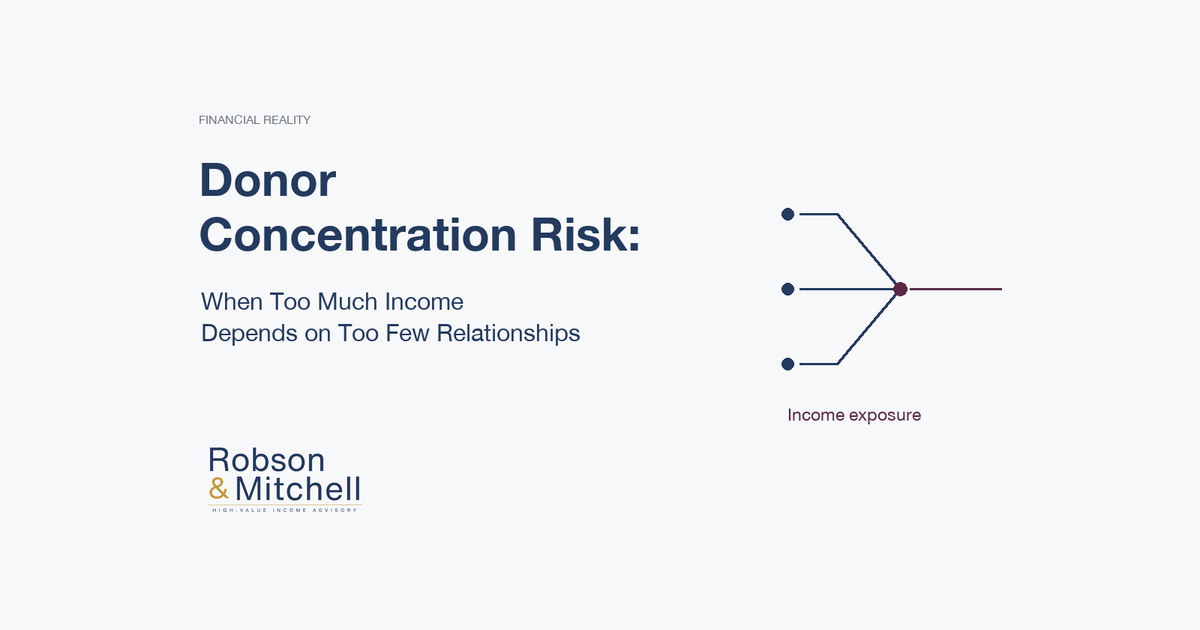

Why apparently healthy fundraising income can conceal significant financial exposure and what CEOs, trustees and fundraising leaders should do about it.
An organisation can be meeting its fundraising targets, maintaining strong donor relationships and reporting healthy income, while carrying a level of financial risk that its leadership has not fully recognised. The problem is donor concentration. When a significant proportion of an organisation's income depends on a relatively small number of major donors, trusts, foundations or corporate partners, financial stability can become more fragile than headline performance suggests.
This is particularly relevant to organisations that have built successful high-value fundraising programmes around a handful of substantial, longstanding relationships. Those relationships may be strong. The donors may be engaged. Funding may have been recommited consistently for several years. But none of these factors eliminates concentration risk.
A strong relationship is not the same as secure future income.
And when too much income depends on too few relationships, even relatively small changes in donor priorities, leadership, funding strategies or organisational circumstances can have disproportionate consequences. The question for leadership is not simply whether those relationships are performing today. It is whether the organisation could absorb the financial consequences if one or more of them changed.
Major donor fundraising is by nature concentrated. A relatively small number of individuals, families, foundations and partners will often account for a substantial proportion of high-value income. That is not inherently problematic. Securing and sustaining significant funding relationships is a central objective of effective high-value fundraising. The risk emerges when an organisation becomes structurally dependent on those relationships without recognising, managing or planning for that dependency.
Consider a hypothetical charity generating £4 million annually. Of that income, £2.2 million comes from five major funding relationships. Those relationships have been stable for several years. The fundraising team knows the donors well. The CEO is confident in the partnerships. The board sees strong income performance.
On the surface, this appears to be a successful fundraising operation. Yet 55% of the organisation's annual income depends on five funding decisions. If one major funder changes strategy, another reduces its commitment and a third delays a recommitment decision, the consequences could be substantial. The organisation may suddenly face difficult decisions about staffing, programme commitments, unrestricted expenditure or future investment. Nothing necessarily went wrong with the fundraising relationships. The vulnerability was already present in the income structure.
Concentration risk is often created during periods of fundraising success, but only becomes visible when income comes under pressure.
Most organisations monitor fundraising performance against budgets and targets. Leadership teams receive reports showing income secured, income forecast, pipeline opportunities and progress against annual objectives. These are necessary measures. But they do not always provide a sufficiently clear picture of financial exposure. An organisation might report:
All of these statements could be accurate. Yet the organisation may still face serious concentration risk. The issue is that traditional fundraising reporting often focuses on income performance rather than income resilience. Performance tells leadership how much income has been secured or is expected. Resilience tells leadership how exposed the organisation is if its assumptions prove incorrect. These are different questions.
A £5 million fundraising pipeline, for example, provides limited reassurance if most of its value depends on a small number of uncertain decisions. Similarly, a strong recommitment history does not guarantee that future recommitments will follow the same pattern. Effective oversight requires leadership to understand not only the amount of income expected, but also the relationships, assumptions and organisational conditions on which that expectation depends.
At Robson & Mitchell, we believe donor concentration should be examined through four connected dimensions: financial reality, leadership and governance, operational capacity, and income performance. Looking at concentration through only one of these lenses can lead organisations to misunderstand the nature of their exposure.
The starting point is understanding the organisation's actual financial dependence on its most significant funding relationships. This requires more than identifying the ten largest donors. Leadership needs to understand how much income is concentrated, how secure that income is, and what would happen if it changed. Useful questions include:
The distinction between committed and anticipated income is particularly important. A donor who has supported an organisation for ten years may be highly engaged and positively disposed towards its work. But if their next contribution has not been agreed, it remains a future funding decision. That uncertainty should be recognised in financial planning.
Similarly, two funding relationships may appear independent but be exposed to the same external conditions. Several foundations may be responding to similar investment market pressures. Corporate partners may operate within the same sector. Individual major donors may share philanthropic interests or networks. Understanding concentration therefore requires looking beyond donor numbers to the underlying sources of risk.
The objective is not to assume that major donors will withdraw. It is to understand the consequences if they do.
Donor concentration is frequently treated as a fundraising management issue. In reality, material concentration is an organisational risk. It affects financial planning, strategic decisions, operational commitments and long-term sustainability. That makes it a legitimate concern for CEOs, finance directors and trustees, as well as fundraising leaders. A common governance weakness arises when senior leaders receive reassuring income forecasts without sufficient visibility of the assumptions behind them.
The board may know that major donor income is expected to reach £3 million. But does it know how much of that figure depends on three individuals making positive decisions? Does it understand which recommitments are genuinely secure? Does it know whether the CEO's involvement is essential to retaining particular relationships? And has it considered the consequences if anticipated funding arrives six months later than expected?
These are not questions that require trustees to become involved in day-to-day fundraising. They are questions about financial oversight and organisational resilience. Effective governance means understanding the scale of exposure, the actions being taken to manage it, and the circumstances that should trigger additional leadership attention. It also requires clarity about who owns significant relationships.
In some organisations, a major donor relationship effectively belongs to one senior fundraiser, CEO or trustee. The relationship may be extremely strong, but institutional knowledge is limited. If that individual leaves, becomes unavailable or changes role, the organisation can find itself exposed.
Relationship strength should sit within the organisation, not depend entirely on one individual.
It requires deliberate stewardship, appropriate leadership engagement and clear accountability.
High-value fundraising is often resource-intensive. Meaningful donor relationships require attention, preparation, responsiveness and coordination. Yet fundraising teams frequently operate with competing demands, complex internal approval processes and limited senior leadership availability. This creates a risk that is less visible than declining income but can be equally important.
An organisation may have a portfolio of substantial donors whose future support depends on continued confidence and engagement. However, the team responsible for those relationships may be overstretched. Stewardship activity becomes reactive. Important conversations are postponed. Proposals are delayed by internal decision-making.
The CEO's involvement is requested too late. Responsibility for next steps becomes unclear. None of these issues necessarily produces an immediate financial loss. But over time, they can weaken relationship quality and reduce the organisation's ability to anticipate changes in donor priorities.
The danger is particularly acute when the same fundraising team is expected to protect existing high-value income while delivering ambitious growth targets. Without clear prioritisation, attention can become fragmented. The organisation may invest significant effort in developing new prospects while not protecting the relationships on which current delivery depends. This is not simply a question of fundraising productivity. It is a question of whether operational capacity is aligned with financial exposure.
If a small number of relationships underpin a significant proportion of income, the organisation must ensure that those relationships receive the attention, leadership support and decision-making capacity they require.
A healthy fundraising pipeline should do more than generate future income. Over time, it should also improve the resilience of the income model. This does not necessarily mean replacing major donors with smaller gifts or reducing the value of established partnerships. It means ensuring that growth does not create additional dependence without a deliberate decision to accept and manage that risk.
For example, a charity heavily reliant on three foundations may secure another substantial grant from one of those existing funders. That is a positive fundraising outcome. But it may also increase concentration. Similarly, a fundraising strategy that consistently prioritises the largest immediate opportunities may deliver short-term growth while doing little to broaden the underlying funding base.
Leadership therefore needs to distinguish between two types of pipeline performance, as they both matter:
Income generation: How much additional income is likely to be secured?
Income resilience: Will that income strengthen or weaken the organisation's overall funding position?
A pipeline dominated by a small number of large, uncertain opportunities may look impressive in financial terms. But its ability to protect future income could be limited. A more resilient approach balances the development of significant relationships with a deliberate assessment of funding diversity, recommitment exposure and the time required to build alternative sources of support.
Donor concentration rarely becomes a problem overnight. More often, exposure accumulates gradually while income performance appears relatively stable. There are several warning signs that should prompt closer scrutiny.
First, the same relationships dominate income forecasts year after year. Longstanding relationships can be valuable, but repeated dependence without meaningful diversification may indicate that the funding model is not becoming more resilient.
Second, leadership confidence rests heavily on personal relationships. Statements such as "we know them very well" or "they have always supported us" may reflect genuine confidence. They are not substitutes for evidence of future funding intentions.
Third, renewal assumptions are stronger than the available evidence. Forecasts may rely on anticipated recommitments without sufficiently accounting for changes in donor strategy, timing, programme priorities or decision-making.
Fourth, the organisation cannot explain what would happen if its largest funder withdrew. If the financial and operational consequences have not been modelled, leadership may be underestimating its exposure.
Fifth, fundraising growth depends on securing increasingly large commitments from an increasingly narrow group of supporters. This may deliver impressive short-term results while creating a progressively more fragile income structure.
Individually, these signs do not prove that an organisation is facing an imminent funding problem. However together, they suggest that donor concentration deserves greater leadership attention.
When donor concentration is identified, the instinctive response is often to diversify. Find more donors. Submit more applications. Expand the prospect pipeline. Develop new corporate relationships. Those actions may be appropriate. But they rarely resolve the immediate problem. Diversifying high-value income takes time.
Building relationships with major donors and foundations can require sustained engagement before significant financial commitments are made. An organisation facing recommitment exposure within six months cannot assume that an expanded prospecting programme will generate replacement income in time.
There is also a more fundamental issue. If the organisational conditions that created concentration remain unchanged, additional fundraising activity may simply reproduce the same weaknesses. Unclear relationship ownership will still undermine progress. Slow decision-making will still delay opportunities. Leadership involvement may remain inconsistent. An overstretched team may struggle to balance stewardship with new business development. And an unclear or poorly aligned proposition may continue to limit conversion.
The solution therefore needs to address both existing exposure and the organisational conditions affecting future income.
Diversification is a long-term resilience strategy. Income protection is an immediate leadership responsibility. Both are necessary, but they operate on different timescales.
The most effective response to donor concentration is not necessarily a major fundraising restructure. It begins with a clearer understanding of risk and a disciplined approach to managing it. We recommend five practical actions.
Identify the funding relationships that account for the largest proportion of income. Assess their value, recommitment dates, restrictions, confidence levels and potential financial impact. Distinguish between income already committed and income that remains dependent on future donor decisions. The aim is to give leadership an evidence-based picture of the organisation's financial exposure.
Review the assumptions underpinning major donor and foundation income forecasts. Ask what evidence supports expected recommitments. Consider plausible scenarios involving delayed decisions, reduced commitments or withdrawals. Model the implications for cash flow, unrestricted income and organisational commitments. Not every risk will materialise. But leadership should understand the consequences of those that could.
Identify the relationships where income exposure is greatest and where action could materially improve confidence or reduce risk. Confirm who owns each relationship, what needs to happen next and what leadership involvement is required. Ensure that operational barriers are removed. In some cases, protecting a handful of relationships may be more financially important than pursuing a large volume of lower-probability opportunities.
Donor concentration should form part of regular income-risk reporting. Trustees do not need extensive operational detail. They need a clear understanding of:
This shifts the conversation from fundraising activity towards financial resilience.
Alongside immediate income protection, organisations should consider how their funding model can become less vulnerable over time. That may involve broadening the major donor portfolio, strengthening trust and foundation prospect development, improving proposition relevance or developing additional high-value partnerships.
Crucially, these decisions should be based on realistic organisational capacity and market opportunity. A diversification strategy that the organisation cannot resource or execute will provide little protection. The objective is not simply a larger pipeline. It is a funding model with greater resilience, clearer ownership and more reliable income performance.
Donor concentration is not evidence of fundraising failure. In many cases, it is a consequence of fundraising success. Substantial, longstanding relationships are valuable assets, and organisations should continue to invest in them. The challenge is ensuring that those relationships do not become unrecognised points of financial vulnerability. For CEOs and trustees, this requires a shift in perspective.
Rather than asking only: "Are we on track to achieve our fundraising target?"
Leadership should also ask: "How much of our future income depends on a small number of decisions and how confident are we that we can manage the consequences if those decisions change?"
The answer may reveal a more complex picture than headline fundraising performance suggests. And that is precisely why it matters. Financial resilience does not come from avoiding substantial funding relationships. It comes from understanding the exposure they create, protecting them appropriately and ensuring the organisation has the leadership, governance and operational capacity to manage them.
Strong income performance matters. But sustainable income requires an understanding of the risks beneath the headline figures.
At Robson & Mitchell, we work with CEOs, trustees and fundraising leaders to identify and address the underlying factors affecting high-value income performance. Our Income Performance Assessment examines donor concentration, recommitment exposure, pipeline performance and the organisational conditions that influence income security.
We help leadership teams understand where income is exposed, what is driving that exposure and which practical actions will make the greatest difference. Our approach brings together financial reality, leadership and governance, operational capacity, and income performance. Because protecting high-value income requires more than strong fundraising relationships. It requires an organisation capable of sustaining them.
Robson & Mitchell | High-Value Income Advisory
Building predictable, scalable high-value income.